RBQ 15.3 Exam Preparation - Owner-Builder in Oil Burner Systems | Prof-RBQ.ca
Complete Strategic Guide: Earning the RBQ 15.3 Licence - Owner-Builder in Oil Burner Systems
1. What is the RBQ 15.3 licence and who needs it?
The RBQ 15.3 sub-category - Owner-Builder in Oil Burner Systems - qualifies its holder to act as the repondant (qualified representative) for construction work on oil-burning heating systems in Quebec. Anyone taking legal responsibility for this work under a Regie du batiment du Quebec (RBQ) contractor or owner-builder licence must pass this exam. Prof-RBQ.ca prepares you for it entirely in English.
2. Scope of the licence: what work does it authorize?
This sub-category authorizes construction work on oil burner systems - the equipment that stores, supplies and burns fuel oil to heat a building. In practice the licence covers the oil storage tank and its clearances, burial and protection; the oil supply piping with its materials, joining, sizing and pressure testing; the oil-fired appliance and its burner (vaporizing or atomizing), with flame monitoring and safety controls; the combustion-air supply; and the flue-gas venting - vent connectors, vents, terminations and chimney flues. All of it is governed by CAN/CSA-B139 Series:19, the installation code for oil-burning equipment. Work reserved to other sub-categories - such as natural-gas or propane burners (15.2), hydronic heating (15.4) or refrigeration - is not covered by 15.3.
3. Format of the RBQ exam: what to expect
- Question type: multiple choice
- Duration: 3 hours (180 minutes)
- Passing grade: 60%
- Languages: French or English
- Scope assessed: 4 content areas covering 12 competency elements (84 skills)
- Cognitive level: a mix of understanding, application and analysis - including several calculation skills (oil-pipe sizing, combustion-air openings, vent and vent-connector sizing, pressure-test values)
4. Documentation at the exam: open book vs closed book
The RBQ 15.3 exam is partly open book: the installation code and reference tables below are provided on site, along with a calculator, while the legal and regulatory framework must be studied and memorized.
Documents PROVIDED at the exam (open book)
- CAN/CSA-B139 Series:19 - Installation code for oil-burning equipment - the core standard covering oil storage, supply piping, appliances, burners, combustion air and venting.
- CMMTQ combustion-efficiency tables - reference tables used for combustion and efficiency calculations.
Framework to MEMORIZE (closed book)
- Building Act (B-1.1) - the umbrella statute administered by the RBQ.
- Construction Code & Safety Code chapters - how CAN/CSA-B139 is adopted and enforced in Quebec.
- Petroleum Products Act (P-29.1) and the Act respecting occupational health and safety (S-2.1) - storage, environmental and worker-safety obligations.
- Licensing & competency-card rules (F-5, R-20) - specialized-contractor limits and workforce competency requirements.
5. The 4 content areas and 18 lessons
Module 1 - Definitions & Types of Systems (25%)
The heating value of fuel oil compared with other fuels; pressure, temperature, heat and capacity; the grades and types of heating oil; storage, oil-piping and air/venting terminology; the components of oil storage and supply; venting types (conventional and direct-vent); flame monitoring, pilots and safety devices.
Module 2 - Legislative, Normative & Regulatory Framework (15%)
The Building Act, the Petroleum Products Act and occupational-health-and-safety legislation, licences and competency cards; the Construction and Safety Code chapters; the standards (CAN/CSA-B139, ASHRAE) and certification marks; scope of application and municipal regulation.
Module 3 - Reading Plans & Specifications (15%)
Locating oil-heating elements on drawings, symbols, dimensions and annotations, details, notes and tables, quantity take-off; and reading construction specifications (the 17-division and 49-division systems, tanks, fuel piping, equipment and electrical sections).
Module 4 - Standards & Execution of Work (45%)
The heart of the exam: oil storage (clearances, burial, support, protection, maximum quantity, signage); combustion-air supply; oil supply piping (materials, joining, purging, sizing, firewalls and pressure testing); burner and appliance installation (clearances to combustibles, service access, start-up); flue-gas venting (connector and vent sizing, terminations and chimney flues); and worker health and safety.
6. Key technical competencies (official context)
Oil grades and heating value set the appliance
An oil system starts from the fuel: heating-oil grades differ in heating value, viscosity and burner requirements, and the appliance and burner (vaporizing or atomizing) must be matched to the grade and the building load. The exam expects you to relate the heating value of the oil to the input and output of the appliance and to select components accordingly.
Oil storage: clearances, burial and protection
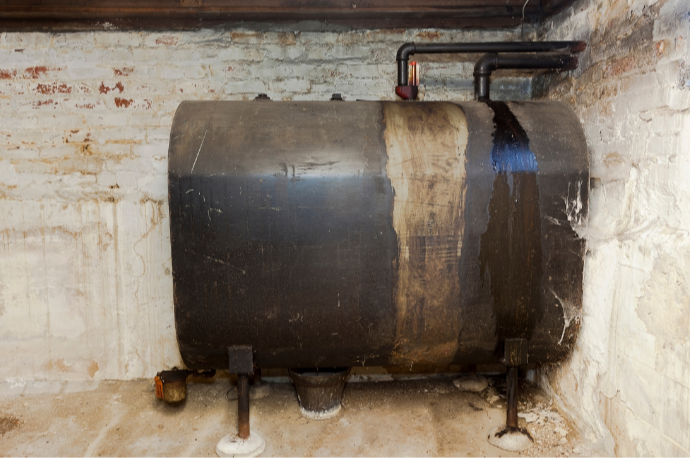
An oil storage tank must respect clearances to the property line, to sources of ignition and to building openings; buried tanks need adequate cover, support and corrosion protection; and the maximum stored quantity and signage follow CAN/CSA-B139. Getting a clearance or burial detail wrong is a classic marks-loser the exam targets.
Oil supply piping: materials, sizing and testing
Oil supply piping is selected for the right materials and support, joined and purged correctly, sized for the appliance's firing rate, protected where it crosses firewalls, and proved by a pressure test before oil is admitted. CAN/CSA-B139 fixes the sizing tables and test values the exam draws on.
Combustion-air supply and the 400,000 BTU/h split
Openings that supply outdoor combustion air are sized from the total input, with requirements that split at 400,000 BTU/h; larger inputs and confined spaces may require mechanical make-up air. Starving an oil burner of combustion air produces incomplete combustion, soot and carbon monoxide - a safety point the exam checks.
Flue-gas venting: sizing and termination clearances
Vent connectors and vents are sized to the appliance input and category, and vent termination clearances protect against flue-gas re-entry near windows, air intakes and grade. Where an existing chimney flue is reused, its condition and lining must suit the oil appliance. Choosing the wrong vent material or termination is frequently tested.
Flame monitoring, pilots and safety devices
Oil burners rely on flame-monitoring and safety controls - flame detectors, primary controls, limit and safety shut-offs - to prove ignition and shut down safely on a fault. Understanding how these devices sequence start-up and lockout is part of the definitions and execution modules and appears on the exam.
7. Preparation strategy and tips for success
Move through the material in exam order: build the vocabulary and system types first, lock down the legal and code framework, practise reading real plans and specifications, then drill the execution rules and the CAN/CSA-B139 calculations. Learn to find a clause or table fast - because you hold this code and the CMMTQ tables at the exam, speed of navigation matters as much as memory. Prof-RBQ.ca's 18 lessons, 180-question bank, visual quiz and flashcards follow exactly this progression.
8. Why Prof-RBQ.ca is the best way to prepare
Prof-RBQ.ca is built by mapping every lesson and question to the official RBQ competency profile and anchoring the content to the exact clauses and tables of CAN/CSA-B139 Series:19 and the CMMTQ combustion-efficiency tables. Nothing is generic: the calculations, clearances and code references are the ones the exam actually asks. It is the only complete English preparation package for RBQ 15.3.
Frequently asked questions
What does the RBQ 15.3 licence cover?
The RBQ 15.3 sub-category - Owner-Builder in Oil Burner Systems - authorizes construction work on oil-burning heating systems: the oil storage tank, the oil supply piping, the oil-fired appliance and its burner, combustion-air supply and flue-gas venting, all governed by CAN/CSA-B139 Series:19. Work reserved to other sub-categories, such as natural-gas or propane burners (15.2) or hydronic heating (15.4), is not covered. Prof-RBQ.ca maps its 18 lessons directly to the RBQ competency profile for this sub-category.
How long is the RBQ 15.3 exam?
The RBQ 15.3 qualification exam lasts 3 hours (180 minutes) and is multiple choice. Prof-RBQ.ca builds your speed and accuracy with a 180-question bank and a 12-question demo so you are comfortable within the time allowed.
What is the pass mark for the RBQ 15.3 exam?
The pass mark is 60%. The exam is multiple choice. Prof-RBQ.ca's 180-question bank and 12-question demo are built to push you well past that threshold before exam day.
Is the RBQ 15.3 exam open-book or closed-book?
It is partly open-book: the installation code and reference tables are provided on site during the exam, while the legal and regulatory framework is expected knowledge you must memorize. Prof-RBQ.ca teaches you to navigate the provided code quickly and to memorize the framework you are not given.
Which documents are provided at the RBQ 15.3 exam?
The documents provided on site are CAN/CSA-B139 Series:19 (installation code for oil-burning equipment) and the CMMTQ combustion-efficiency tables, along with a calculator. Prof-RBQ.ca's lessons are anchored to the exact clauses and tables of this code so you know where to look.
What is an oil burner system?
An oil burner system stores fuel oil in a tank, delivers it through supply piping to an oil-fired appliance whose burner (vaporizing or atomizing) turns it into heat, draws in combustion air, and evacuates the products of combustion through a vent or chimney flue - all with flame-monitoring and safety controls. Prof-RBQ.ca devotes a full module to system types and components before moving to sizing and execution.
Which code and standards must I study for RBQ 15.3?
The core installation code is CAN/CSA-B139 Series:19 (oil-burning equipment), used together with the CMMTQ combustion-efficiency tables. To these you add the legal framework you must memorize: the Building Act (B-1.1), the Petroleum Products Act (P-29.1) and occupational-health-and-safety legislation (S-2.1), the Construction and Safety Code chapters that adopt these standards in Quebec, and the licensing and competency-card rules. Prof-RBQ.ca cites each one by its official English title and clause reference.
What calculations appear on the RBQ 15.3 exam?
Expect oil-pipe sizing from the appliance firing rate, combustion-air opening sizing, vent and vent-connector sizing, heating-value and combustion-efficiency calculations from the CMMTQ tables, and pressure-test values. Prof-RBQ.ca includes worked calculation questions for each of these.
Can I take the RBQ 15.3 exam in English?
Yes. The RBQ offers this exam in French or English. Prof-RBQ.ca provides a complete English version - 18 lessons, a 180-question bank, a visual quiz and flashcards - aligned with the official English titles of CAN/CSA-B139 and the Quebec laws.
How should I prepare for the RBQ 15.3 exam?
Work in exam order: build the terminology and system types first, master the legal and code framework, practise reading plans and specifications, then drill the execution rules and the CAN/CSA-B139 calculations. Because you hold this code and the CMMTQ tables at the exam, speed of navigation matters as much as memory. Prof-RBQ.ca structures its 18 lessons, 180-question bank, visual quiz and flashcards in exactly this order.