RBQ 15.6 Practice Test | Propane Certification
This online training offers purely theoretical and conceptual teaching. Users must consult and comply with current official codes and regulations before any practical application. In the event of a discrepancy, the regulatory texts systematically prevail over the educational content presented.
Online
Course
Now
Serge Williams
16 hours
32 minutes
3 Months
About the course
Practical approach
Globally oriented
For your career
Course Lessons
Complete Strategic Guide: Obtaining the RBQ 15.6 Licence – Propane Contractor
1. What Is the RBQ 15.6 Licence and Who Needs It?
The RBQ 15.6 licence — Propane Contractor (Entrepreneur en propane) — is a specialized licence issued by the Régie du bâtiment du Québec (RBQ) for contractors who install, maintain and service propane systems. It authorizes construction work related to installations intended to use, store or distribute propane, including:
- Propane piping — installation, sizing, pressure testing and connections per CAN/CSA-B149.1;
- Propane storage — cylinders, tanks, clearances, maximum quantities and signage per CAN/CSA-B149.2;
- Combustion and dilution air supply — sizing of openings and ducts for propane appliances;
- Propane appliances — installation of construction heaters, torches, decorative fireplaces, pool heaters, water heaters, commercial cooking equipment and domestic ranges;
- Flue gas venting — vent connectors, vent pipes and chimneys for propane-fired appliances;
- Safety systems — leak detection, emergency shut-off valves and pressure regulation.
Important distinction: The RBQ 15.6 is a contractor licence (entrepreneur), not an owner-builder licence. Work reserved exclusively to master pipe mechanics is excluded from this licence's scope. With 92 skills across 4 modules and 12 competency elements, the exam covers the complete propane installation chain from storage to appliance venting.
2. Scope of the Licence: Propane from Storage to Venting
The RBQ 15.6 covers the installation, modification and servicing of complete propane systems — from the storage container (cylinder or tank) through the piping network to the appliance and its flue gas venting. What makes this licence distinctive within category 15 is its exclusive focus on propane as a fuel, combined with the unique safety considerations that propane's physicochemical properties demand.
Propane (C₃H₈) is a liquefied petroleum gas that is heavier than air — a critical safety characteristic that fundamentally affects installation requirements. Unlike natural gas (which rises and disperses), propane in the event of a leak accumulates at ground level, in basements and in any low-lying space, creating a concentrated flammable mixture. This property drives many of the code requirements tested on the exam: restrictions on below-grade installations, specific ventilation requirements, leak detection at floor level, and strict clearance distances for storage containers.
The propane system follows a specific chain: storage (above-ground or underground tanks, or portable cylinders — each with specific clearance, support and signage requirements per CAN/CSA-B149.2), pressure regulation (first-stage and second-stage regulators reducing tank pressure to appliance operating pressure), piping (sized by the longest-run method based on total BTU/h load and pipe length per CAN/CSA-B149.1), appliance connection (with specific requirements for each appliance type), combustion air supply (openings and ducts sized based on total appliance input), and flue gas venting (vent connectors, vent pipes and chimneys with code-specific sizing).
3. RBQ Exam Format: What to Expect
- Question type: Multiple choice (MCQ)
- Duration: 3 hours (180 minutes)
- Passing grade: 60%
- Languages: French or English
- Skills assessed: 92 skills across 12 competency elements
- Exam type: Mixed (6 open-book documents + 5 closed-book documents)
- Tools provided: Calculator, ruler, paper and pencil
With 6 open-book documents and 92 skills, the RBQ 15.6 is a code-navigation-intensive exam. The two CSA standards (B149.1 and B149.2) together with the Construction Code chapters form the backbone of the technical questions. The 5 closed-book documents are primarily legislative — the Building Act and related regulations.
4. Exam Documentation: Open Book vs. Closed Book
The RBQ 15.6 exam is a mixed exam with 6 documents provided (open book) and 5 to memorize (closed book) — 11 documents total.
Documents PROVIDED During the Exam (Open Book)
- Quebec Construction Code, Chapter I — Building 1995 — Contains the building requirements applicable to propane installations, including fire separations, clearances from combustibles and structural provisions for equipment rooms.
- Quebec Construction Code, Chapter II — Gas 2008 — The Quebec-specific gas code chapter covering provincial requirements for gas and propane installations, including amendments to the national standards.
- Safety Code for Construction Work — The safety requirements applicable to construction job sites where propane is used, including temporary heating, hot work and hazardous material handling.
- Regulation Respecting Gas Qualification Certificates — The regulation governing the certification requirements for gas and propane installation work, including the categories of work and qualification requirements.
- CAN/CSA-B149.1-05 — Natural Gas and Propane Installation Code — The central reference for propane piping installation: pipe sizing, connections, pressure testing, appliance installation, combustion air supply and flue gas venting.
- CAN/CSA-B149.2-05 — Propane Storage and Handling Code — The central reference for propane storage: tank and cylinder requirements, clearance distances, maximum quantities, signage, filling procedures and transportation.
Documents to MEMORIZE (Closed Book)
- Building Act — The foundational statute governing construction, safety, and contractor qualifications in Quebec.
- Regulation Respecting the Professional Qualification of Contractors and Owner-Builders — The regulation setting out the qualification requirements, licence categories and conditions for obtaining and maintaining an RBQ licence.
- Safety Code (CQLR, chapter B-1.1) — The code governing the safety of existing buildings and installations, including maintenance, inspection and compliance requirements for propane systems already in service.
- Act Respecting Occupational Health and Safety — The statute governing workplace health and safety, including the rights and obligations of employers and workers on construction sites where propane is present.
- Act Respecting Workforce Vocational Training and Qualification — The statute governing the vocational training and qualification of workers, including the requirements for propane installation work.
5. The 4 Training and Competency Modules
Module 1 — Definitions and Types of Systems (14 skills)
Covers the foundational knowledge of propane systems: physicochemical properties of propane (boiling point, vapour density relative to air, flammability limits, heating value in BTU/ft³ and BTU/lb), types of propane storage (DOT cylinders, ASME tanks — above-ground, underground and mounded), types of pressure regulators (first-stage, second-stage, integral two-stage), types of propane piping (copper, steel, CSST — corrugated stainless steel tubing), types of propane appliances (vented, unvented, direct-vent, power-vented), and the distinction between propane in vapour phase and liquid phase. Also covers basic combustion principles: stoichiometric ratio, complete vs. incomplete combustion, and products of combustion.
Module 2 — Legislative, Normative and Regulatory Framework (14 skills)
Covers the complete regulatory framework for propane installations: the Building Act, the Quebec Construction Code (Chapters I and II), the Safety Code, CAN/CSA-B149.1 for installation, CAN/CSA-B149.2 for storage and handling, the Regulation Respecting Gas Qualification Certificates, the Regulation Respecting the Professional Qualification of Contractors, the Act Respecting Occupational Health and Safety, and the Act Respecting Workforce Vocational Training and Qualification. With 11 documents to master, this module tests the candidate's ability to identify which legislation, code or regulation governs a specific situation.
Module 3 — Plan and Specification Reading (16 skills)
Covers the ability to read and interpret plans and specifications for propane installations: site plans showing storage container locations and clearance distances, floor plans showing piping routes and appliance locations, piping isometric drawings, equipment schedules specifying appliance BTU/h ratings, detail drawings showing regulator stations and venting configurations, propane storage site layouts per CAN/CSA-B149.2, and the National Master Specification divisions relevant to gas installations. This module tests the candidate's ability to extract installation requirements from project documents.
Module 4 — Standards and Work Execution (48 skills, 52%)
The most heavily weighted module on the exam. This module covers the complete propane installation workflow: propane storage installation (cylinder and tank placement, clearances from buildings, property lines and ignition sources per CAN/CSA-B149.2), propane piping (sizing using the longest-run method, materials, fittings, pressure testing at 1.5× operating pressure, purging per CAN/CSA-B149.1), combustion air supply (sizing openings and ducts based on total appliance input), propane appliance installation (specific requirements for each appliance type — construction heaters, decorative fireplaces, pool heaters, water heaters, commercial cooking, domestic ranges, propane engines), flue gas venting (vent connector and vent pipe sizing, chimney requirements, direct-vent and power-vent configurations), and health and safety on propane job sites.
6. Key Competencies and Technical Requirements (Official Context)
Propane Storage: CAN/CSA-B149.2 Clearance Requirements
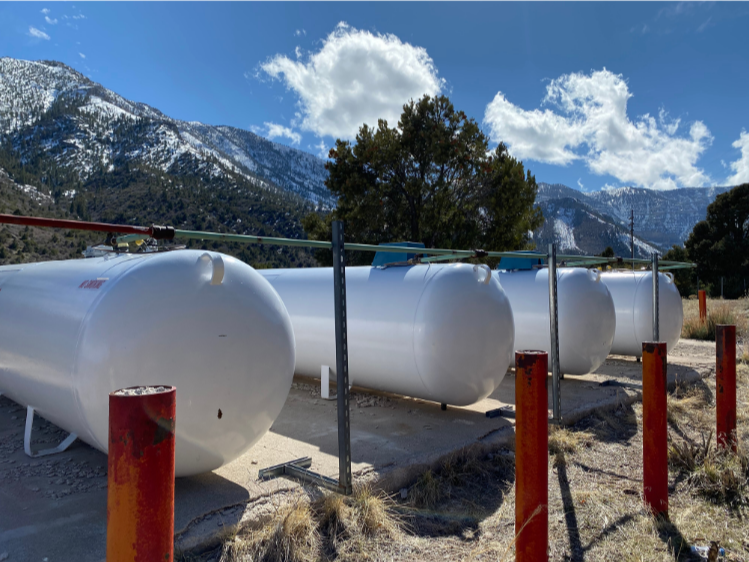
Propane storage is one of the most heavily tested topics on the RBQ 15.6 exam — and the requirements are governed by CAN/CSA-B149.2, which is entirely dedicated to storage and handling. The exam tests candidates on clearance distances that depend on the type and size of the storage container: distances from buildings (measured to the nearest building opening and to the building wall), from property lines, from ignition sources, from public ways, and from other tanks. These distances vary by tank capacity and whether the tank is above-ground, underground or mounded. For cylinders, the exam tests the maximum number and total capacity that may be stored at a single location, the support and restraint requirements (cylinders must be stored upright, secured against tipping), and the restrictions on indoor storage (limited quantities, ventilation at floor level — because propane is heavier than air). The exam also tests signage requirements — the diamond-shaped NFPA 704 placard with the correct hazard ratings, "No Smoking" signs, and identification of propane storage areas.
Propane Piping: Sizing and Pressure Testing per CAN/CSA-B149.1
Propane piping is sized using the longest-run method per CAN/CSA-B149.1 — the same methodology used for natural gas but with propane-specific considerations. The exam tests the complete sizing process: (1) determining the total connected BTU/h load (sum of all appliance input ratings on each pipe section), (2) measuring the equivalent length of the pipe run from the regulator to the most remote appliance (including equivalent lengths for fittings), (3) using the code's pipe sizing table to select a pipe diameter that delivers the required gas volume at an acceptable pressure drop. The exam specifically tests the pressure drop limits (the maximum allowable pressure drop from the regulator to the appliance — typically ½" w.c. for the second-stage piping). Pressure testing is a critical exam topic: the system must be tested at 1.5× the maximum operating pressure for a minimum duration, all joints must be checked with an approved leak detection solution (never an open flame), and the system must hold pressure with no detectable loss. Purging — the procedure for displacing air from the piping with propane before appliance ignition — is tested for both safety procedures and the specific steps required by the code.
Combustion Air Supply for Propane Appliances
Every propane-burning appliance requires an adequate supply of combustion air — and the exam tests the sizing methodology based on the total appliance input in the room or enclosure. The exam focuses on the distinction between confined spaces (rooms with less than 50 ft³ per 1,000 BTU/h of total input — requiring dedicated combustion air openings) and unconfined spaces (rooms with sufficient volume to support combustion through natural air infiltration). For confined spaces, the exam tests the sizing of combustion air openings: two openings (one within 12 inches of the ceiling, one within 12 inches of the floor), each sized at a minimum of 1 in² per 1,000 BTU/h of total input when communicating directly with the outdoors, or 1 in² per 2,000 BTU/h when communicating with an interior space. The heavier-than-air property of propane adds a unique dimension — floor-level ventilation is critical for propane installations because leaked gas accumulates at the lowest point rather than rising and dispersing like natural gas.
Propane Appliances: Type-Specific Installation Requirements
The RBQ 15.6 exam covers a diverse range of propane appliances — each with specific installation requirements that candidates must know. Construction heaters (temporary heating units used on job sites) have specific clearance, ventilation and fuel supply requirements governed by both CAN/CSA-B149.1 and the Safety Code for Construction Work. Decorative radiators and log-effect fireplaces have specific venting requirements (some are direct-vent sealed combustion, others require conventional venting). Pool heaters must be installed outdoors or in well-ventilated spaces with specific clearances. Commercial cooking equipment (ranges, fryers, ovens) has specific exhaust hood and make-up air requirements. Propane refrigerators (absorption-type) have unique venting requirements because the burner operates continuously at low BTU/h input. Propane engines (forklifts, generators) require specific ventilation for indoor operation. The exam tests the candidate's ability to identify the correct installation requirements for each appliance type from the applicable code sections.
Flue Gas Venting for Propane Appliances
Venting combustion gases from propane appliances follows the same general principles as other fuel types — but with propane-specific considerations. The exam tests the four venting categories: Category I (natural draft, non-positive pressure — conventional B-vent or chimney), Category II (non-positive pressure, condensing — rarely used), Category III (positive pressure, non-condensing — special vent materials), and Category IV (positive pressure, condensing — plastic pipe sidewall venting). For each category, the exam tests vent sizing (based on appliance input and vent height), vent materials, termination requirements and clearances from combustibles. Direct-vent appliances (sealed combustion — drawing combustion air from outdoors and venting directly through a wall) have become increasingly common for propane and have specific clearance requirements from windows, doors, air intakes and property lines. The exam also tests common venting — connecting multiple appliances to a single vent or chimney — including the sizing methodology and the restrictions on which appliance types may share a vent.
The Dual-Code Structure: B149.1 and B149.2
A unique challenge of the RBQ 15.6 exam is that propane is governed by two separate CSA standards — and candidates must know which code applies to which aspect of the installation. CAN/CSA-B149.1 (Installation Code) governs everything downstream of the storage container: piping from the first-stage regulator to the appliance, pressure regulation, appliance installation, combustion air and venting. CAN/CSA-B149.2 (Storage and Handling Code) governs everything related to the storage container itself: tank and cylinder placement, clearances, filling procedures, transportation, signage and emergency procedures. The dividing line is the outlet of the first-stage regulator — upstream is B149.2 territory, downstream is B149.1 territory. Confusing which code applies to a specific requirement is a common exam pitfall. Both codes are provided at the exam, but candidates must navigate between them efficiently.
7. Preparation Strategy and Tips for Success
The RBQ 15.6 exam covers 92 skills across 4 modules with 6 open-book and 5 closed-book documents. Here is a recommended strategy:
Phase 1 — Master CAN/CSA-B149.1 and CAN/CSA-B149.2 (both provided at the exam). These two codes are the technical backbone of the exam. Learn the structure of each code so you can find specific requirements quickly: pipe sizing tables, clearance tables for storage, pressure testing requirements, appliance-specific sections, and combustion air provisions. Understand the boundary between the two codes (the first-stage regulator outlet).
Phase 2 — Learn the Construction Code and Safety Code provisions. The Quebec Construction Code Chapters I (Building) and II (Gas) and the Safety Code for Construction Work are provided at the exam. Focus on the gas-specific provisions: equipment room requirements, fire separations, clearances from combustibles, and construction site safety requirements for propane use.
Phase 3 — Memorize the five legislative documents. The closed-book documents are all legislative — the Building Act, the Professional Qualification Regulation, the Safety Code, the OHS Act and the Workforce Training Act. Focus on the key articles that define contractor obligations, licence requirements, permit conditions and worker safety responsibilities.
Phase 4 — Master the appliance-specific requirements. The exam tests a wide range of propane appliances — each with unique installation requirements. Study each appliance type systematically: clearances, venting requirements, combustion air needs and any special provisions.
Phase 5 — Complete full timed simulations. With 92 skills and 6 open-book documents, you have roughly 117 seconds per question. Practice navigating between CAN/CSA-B149.1, CAN/CSA-B149.2 and the Construction Code under timed conditions with Prof-RBQ.ca.
Frequently Asked Questions
What is the RBQ 15.6 licence — Propane Contractor?
The RBQ 15.6 licence authorizes construction work related to installations intended to use, store or distribute propane, including their components and accessories. This covers propane piping installation, storage (cylinders and tanks), combustion air supply, propane appliance installation and flue gas venting. Work reserved exclusively to master pipe mechanics is excluded. Prof-RBQ.ca offers a comprehensive course covering the 4 modules and 92 skills assessed on the exam.
How long is the RBQ 15.6 propane contractor exam?
The RBQ 15.6 — Propane Contractor exam lasts 3 hours (180 minutes). It is a multiple-choice exam covering 92 skills across 12 competency elements. Prof-RBQ.ca helps you manage your time effectively with timed exam simulations.
What is the passing grade for the RBQ 15.6 exam?
The passing grade for the RBQ 15.6 exam is 60%. With 92 skills assessed across 4 modules and 12 competency elements, structured preparation is essential. Prof-RBQ.ca organizes its lessons and quizzes by module to ensure complete coverage of the competency profile.
Is the RBQ 15.6 exam open book or closed book?
The RBQ 15.6 exam is a mix of open book and closed book: 6 documents are provided at the exam (open book) and 5 documents must be memorized (closed book). The provided documents include the Quebec Construction Code Chapters I and II, CAN/CSA-B149.1, CAN/CSA-B149.2 and the Safety Code for Construction Work. Prof-RBQ.ca teaches you to navigate these references efficiently.
What documents are provided during the RBQ 15.6 exam?
Six documents are provided at the RBQ 15.6 exam: (1) the Quebec Construction Code, Chapter I — Building 1995, (2) the Quebec Construction Code, Chapter II — Gas 2008, (3) the Safety Code for Construction Work, (4) the Regulation Respecting Gas Qualification Certificates, (5) CAN/CSA-B149.1-05 — Natural Gas and Propane Installation Code, and (6) CAN/CSA-B149.2-05 — Propane Storage and Handling Code. Prof-RBQ.ca trains you to navigate these six references quickly.
What documents must I memorize for the RBQ 15.6 exam?
Five documents must be memorized (closed book) for the RBQ 15.6 exam: (1) the Building Act, (2) the Regulation Respecting the Professional Qualification of Contractors and Owner-Builders, (3) the Safety Code (CQLR, chapter B-1.1), (4) the Act Respecting Occupational Health and Safety, and (5) the Act Respecting Workforce Vocational Training and Qualification. Prof-RBQ.ca offers flashcards targeting the key articles of these documents.
How many modules and skills are assessed on the RBQ 15.6 exam?
The RBQ 15.6 exam covers 4 modules, 12 competency elements and 92 skills: Definitions and Types of Systems (14 skills), Legislative, Normative and Regulatory Framework (14 skills), Plan and Specification Reading (16 skills), and Standards and Work Execution (48 skills). Module 4 alone accounts for 52% of the exam. Prof-RBQ.ca structures its lessons around each of these modules.
Can I take the RBQ 15.6 exam in English?
Yes, the RBQ 15.6 — Propane Contractor exam can be taken in French or English, according to your preference. Prof-RBQ.ca offers bilingual content with technical terminology aligned with the CSA standards and Quebec codes.
What is the difference between CAN/CSA-B149.1 and CAN/CSA-B149.2 for propane?
CAN/CSA-B149.1 is the Natural Gas and Propane Installation Code — it covers piping, connections, pressure testing and appliance installation. CAN/CSA-B149.2 is the Propane Storage and Handling Code — it covers tanks, cylinders, clearances, signage and transportation. Both are provided at the RBQ 15.6 exam. Prof-RBQ.ca teaches the key sections of each code with practical exercises.
What types of propane appliances are covered by the RBQ 15.6 exam?
The exam covers a wide variety of appliances: construction heaters, torches, decorative radiators and log-effect fireplaces, pool heaters, water heaters, commercial cooking equipment, domestic ranges, propane refrigerators and propane engines. For each type, the candidate must know the specific installation requirements. Prof-RBQ.ca details the requirements specific to each appliance category.
How can I best prepare for the RBQ 15.6 propane contractor exam?
Prof-RBQ.ca offers a structured preparation in 4 modules aligned with the official competency profile. With 92 skills to cover, start with definitions and types of systems (Module 1, 14 skills), then the legislative framework (Module 2, 14 skills and 11 documents to know). Master plan and specification reading (Module 3, 16 skills), then devote significant effort to Module 4 (48 skills) covering storage, piping, combustion air supply, appliances and flue gas venting.
What is the format of the questions on the RBQ 15.6 exam?
The RBQ 15.6 exam consists exclusively of multiple-choice questions (MCQ). Questions cover the 4 modules and assess different levels of Bloom's taxonomy: knowledge of propane definitions, comprehension of CSA standards, application of installation rules and analysis of job site situations. Prof-RBQ.ca reproduces this format in its exam simulations.