CCQ (EN) — Load displacement with a boom truck (shared activity)
Prepare for the CCQ qualification exam for the shared activity of load displacement with a boom truck with an online course: lessons, quizzes with explained answers and review tools, available anytime for 3 months.
The trade at a glance
Under Schedule E of the Regulation respecting the vocational training of workforce in the construction industry (R-20, r. 8), load displacement with a boom truck is a shared activity of the crane operator trade that the holder of a journeyman competency certificate in any trade or specialty may perform.
- It may only be used to move materials, equipment or waste of the holder's own trade, to a temporary storage point, with a boom truck of a maximum capacity of 30 tonnes and a single fixed control station.
- Section 5.8 makes holders eligible for the related qualification examination after recognized training.
Please note — This course prepares you for the CCQ qualification exam. Its content is educational: before applying any concept on a job site, consult the codes, regulations and standards in force, which take precedence in case of discrepancy. Some quizzes refer to paid codes, standards or manuals that are not included and may be required; they are available separately from their publishers. If you do not have the document a question refers to, simply skip that question. Prof-RBQ is independent of the CCQ and the RBQ and does not guarantee success on the exam.
Online course
Now
3 months
Course Lessons
CCQ Boom Truck Operator Shared Activity Qualification Exam Preparation
Online course aligned with the three official sections of the CCQ Boom truck operator shared activity (Activité partagée camion-flèche) qualification exam — practice questions, flashcards, mock exams, and detailed answer explanations covering inspection, on-site operation, and material handling.
1. About the CCQ Boom truck operator shared activity exam
The Boom truck operator shared activity (Activité partagée camion-flèche) qualification exam is the official theoretical evaluation administered by the Commission de la construction du Québec (CCQ). Passing this exam authorizes a worker to operate a boom truck on a CCQ-regulated construction site. Unlike a full trade qualification (such as the Grutier / Crane operator), a shared activity qualification can be earned by workers from various primary trades who need authorization for this specific activity.
The exam covers three sections weighted as follows: Inspecting the boom truck (15%), Operating the boom truck on a construction site (35%), and Handling materials (50%). It is offered in French and English in multiple-choice format and lasts approximately 3 hours, with a passing grade of 60%.
2. Exam structure at a glance
| Section | Title | Weight | Focus |
|---|---|---|---|
| 1 | Inspecting the boom truck | 15 % | Pre-departure inspection, condition logging, rigging inspection |
| 2 | Operating the boom truck on a construction site | 35 % | Engine start-up, site movement, setup, end-of-day storage |
| 3 | Handling materials | 50 % | Hazard recognition, signal interpretation, load charts, rigging verification, lifting |
Section 3 dominates this exam at 50%. The remaining two sections together (50%) cover everything the operator does before a lift; Section 3 covers the lift itself, where every safety-critical decision is made.
3. Detailed competency elements
Section 1 — Inspecting the boom truck (15%)
- Perform the pre-departure boom truck inspection
- Log data related to the boom truck's condition
- Inspect the rigging equipment
Section 2 — Operating the boom truck on a construction site (35%)
- Start the boom truck engine
- Move the boom truck on the construction site
- Set up the boom truck
- Store the boom truck at the end of the work day
Section 3 — Handling materials (50%)
- Recognize potential hazards of lifting work
- Interpret manual lifting signals
- Interpret load charts
- Verify the rigging
- Move materials
4. Documents provided at the exam
This is a defining feature of all CCQ qualification exams: unlike RBQ contractor exams (some of which are open book), CCQ exams are systematically closed book. For a boom truck operator, this means reasoning about load charts and rigging without the chart in front of you.
5. Recommended study documents
The CCQ suggests the following references for preparation. None of them will be available during the exam — they are study aids only. Use them to build understanding, then test recall with practice questions and flashcards.
- Mobile Crane Safety Code (CAN/CSA-Z150-11) — CSA Group, Mississauga, 2012, 132 p. (csagroup.org)
- Rigging and Lifting: Safety Guide — Quebec translation by Marc Pelletier, Publications du Québec, 2006, 174 p. (publicationsduquebec.gouv.qc.ca)
- Safety Code for Construction Work (S-2.1, r.6) — Éditeur officiel du Québec, 2003, 268 p. (publicationsduquebec.gouv.qc.ca)
- Aide-mémoire de prévention — Élingues et accessoires de levage (Slings and Lifting Accessories Prevention Memo) — ASP Construction, 2012 (asp-construction.org)
6. What makes the Boom truck operator exam different
This is a CCQ shared activity qualification, not a full trade exam. The shared activity model exists for tasks that don't constitute a full primary trade but still require dedicated competency: a worker whose main trade is something else (carpentry, ironwork, electrical, etc.) may need to operate a boom truck for delivery and material placement on a site, and the CCQ requires a separate qualification to authorize that. The exam is correspondingly focused — 3 sections, 12 competency elements — rather than the broader scope of a full trade.
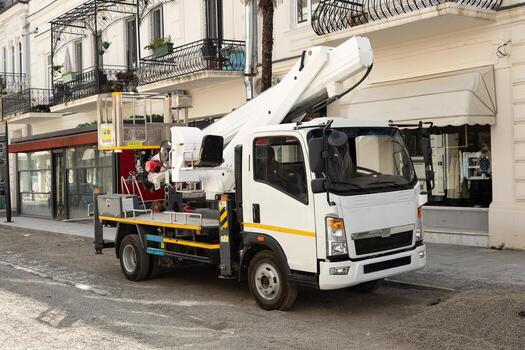
The exam shares its safety foundations with the full Crane operator (Grutier) trade — the same CSA Z150 Mobile Crane Safety Code, the same load chart reading principles, the same manual signal code, the same rigging fundamentals. What's different is scope: this qualification applies specifically to boom trucks (camion-flèche) — truck-mounted articulating cranes used for delivery and on-site material placement — rather than the full range of mobile cranes.
Section 3 (Material handling, 50%) is the heart of the exam. Half the score depends on whether the candidate can recognize lifting hazards, read the boom truck's load chart, interpret signals from the ground crew, verify the rigging, and execute the lift safely. Because the exam is closed book, the platform also tracks what you've actually memorized — flashcards spaced over multiple sessions surface weak areas before exam day.
7. Recommended preparation strategy
- Anchor preparation around Section 3 (50%). Material handling is half the exam. If you can plan and execute a safe lift, you've covered half the score.
- Treat the exam as closed book from day one. Memorize sling capacities, signal codes, and the boom truck load chart structure — you will not have a chart to consult.
- Read the recommended documents in this order: CSA Z150 Mobile Crane Safety Code (the foundation, since boom trucks fall under mobile crane rules), then the Rigging and Lifting Safety Guide and ASP Construction's slings memo (Section 3 rigging depth), then the Quebec Safety Code for Construction Work (S-2.1, r.6) for site-level rules.
- Drill load chart reading and signal codes daily. Both are common Section 3 topics and are easy points if memorized.
- Walk through complete lift sequences. Inspection (Section 1) → setup and outrigger deployment (Section 2) → hazard check, chart read, rigging verification, lift (Section 3). The exam tests whether you can reason about the full sequence end-to-end.
- Take at least two full mock exams under real conditions (3 hours, no documents, single sitting) before scheduling the real exam.
- Review every wrong answer. The Prof-RBQ.ca platform shows the reasoning behind each correct answer — read every explanation, even on questions you got right.
8. Why Prof-RBQ.ca for the Boom truck operator exam
- Aligned with the official CCQ structure — content mapped one-to-one to the three sections, with extra depth on Section 3 (material handling) and dedicated drilling on load charts, signal codes, and rigging verification.
- Closed-book training methodology — flashcards and spaced practice designed for memorization of charts, capacities, and signal codes.
- Mock exams in CCQ format — multiple choice, 3-hour timing, scoring out of 60% — so exam day feels familiar.
- Detailed answer explanations — every question, right or wrong, comes with a written rationale.
- Bilingual — full course in English and French. The CCQ exam itself is offered in both languages.
- A free section is available so you can try the platform before committing.
Get ready for your CCQ Boom truck operator exam
Online course, mock exams, flashcards, and answer explanations — built for the closed-book CCQ format and the boom truck shared activity scope.
Access Prof-RBQ.caFrequently asked questions
What is the CCQ Boom truck operator shared activity qualification exam?
The CCQ shared activity qualification exam for boom truck operators (Activité partagée camion-flèche) is the official theoretical exam administered by the Commission de la construction du Québec authorizing a worker to operate a boom truck on a Quebec construction site. It evaluates competencies across three sections: Inspecting the boom truck (15%), Operating the boom truck on a construction site (35%), and Handling materials (50%). It is a shared activity qualification rather than a full trade — workers from various primary trades can earn it.
Is the Boom truck operator exam open book or closed book?
The CCQ Boom truck operator shared activity exam is entirely closed book. No reference document is provided during the exam and personal documents are not allowed. Load charts, sling capacities, signal codes, and the relevant safety code rules must be memorized — focus your preparation on understanding rather than locating information in a manual.
How long is the exam and what is the passing grade?
The CCQ Boom truck operator shared activity exam typically lasts 3 hours and the passing grade is 60%. The exam is offered in French and English in multiple-choice format. Confirm the official details on the CCQ website before your exam date.
What are the three sections of the exam?
The exam is divided into three sections: Section 1 — Inspecting the boom truck (15%); Section 2 — Operating the boom truck on a construction site (35%); Section 3 — Handling materials (50%). Section 3 is the dominant block at half the exam, reflecting that the core purpose of a boom truck on a site is moving material safely under load.
What does Section 1 — Inspecting the boom truck cover?
Section 1 (15%) covers performing the pre-departure boom truck inspection, logging data related to the boom truck's condition, and inspecting the rigging equipment used during lifts.
What does Section 2 — Operating the boom truck on site cover?
Section 2 (35%) covers starting the boom truck engine, moving the boom truck on the construction site, setting up the boom truck (including outrigger deployment for lifts), and storing the boom truck at the end of the work day.
What does Section 3 — Handling materials cover?
Section 3 (50%) covers recognizing potential hazards in lifting work, interpreting the manual lifting signal code, interpreting load charts, verifying the rigging before lifting, and moving materials. This is the operational heart of the qualification — half the exam tests whether the candidate can plan and execute a safe lift with a boom truck.
What documents are recommended for exam preparation?
The CCQ recommends four references: the CSA Mobile Crane Safety Code (CAN/CSA-Z150-11, 2012, 132 p.); the Rigging and Lifting Safety Guide (Quebec translation by Marc Pelletier, 2006, 174 p.); the Quebec Safety Code for Construction Work (S-2.1, r.6, 2003, 268 p.); and ASP Construction's Slings and Lifting Accessories Prevention Memo (2012). None of these documents are provided at the exam — they are study references only.
How is this different from the full Crane operator (Grutier) exam?
The Boom truck operator shared activity is a focused subset of the full Crane operator (Grutier) trade. It applies specifically to boom trucks (camion-flèche) — truck-mounted articulating cranes used for delivery and material placement on sites — rather than the full range of mobile cranes covered by the Grutier qualification. The exam structure is also simpler: 3 sections and 12 competency elements vs. 4 sections and 39 elements for the full trade. As a shared activity, this qualification can be earned by workers whose primary trade is something other than crane operator, allowing them to legally operate a boom truck on a CCQ-regulated site.
Why is material handling 50% of the exam?
Section 3 (Material handling, 50%) is dominant because material handling is the entire purpose of a boom truck on a construction site. Every safety-critical decision — hazard recognition, signal interpretation, load chart reading, rigging verification, and the actual lift — happens during this phase. The exam reflects the field reality that what goes wrong with a boom truck almost always goes wrong while it's lifting, not while it's parked or driving. A candidate cannot pass this exam from inspection or driving knowledge alone.
How does Prof-RBQ.ca prepare me for the Boom truck operator exam?
Prof-RBQ.ca offers an online preparation course aligned with the three official CCQ sections, with practice questions, flashcards, mock exams, and detailed explanations for every wrong answer. The platform mirrors the multiple-choice format of the actual exam so you arrive prepared, with extra emphasis on Section 3 (the dominant material handling block) and dedicated drilling on load chart reading, signal codes, and rigging verification.
How do I register for the Boom truck operator preparation course?
Visit Prof-RBQ.ca to access the Boom truck operator shared activity preparation course. A free section is available so you can try the platform before committing. Pricing and registration are available on Prof-RBQ.ca.